

The funeral mask
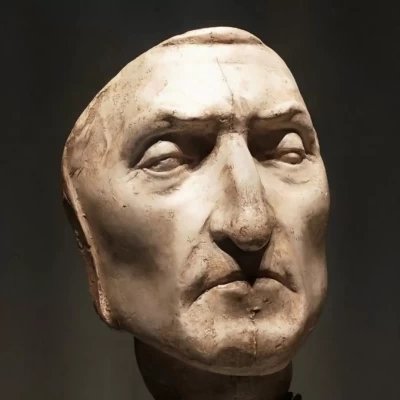 The mask of Dante, housed in the Palazzo Vecchio in Florence, is shrouded in mystery and intrigue. Originally considered a death mask created from the poet's face shortly after his demise, recent research has led to a reevaluation of this interpretation. It is now believed that the mask was derived from a cast of a sculptural portrait of Dante, which has been lost over time.
This precious relic was donated to the Municipality of Florence in 1911 by Alessandro D'Ancona, who had received it as a gift in 1901 from the widow of Seymour Kirkup, a renowned English Dante scholar. According to D'Ancona, the mask was discovered by the artist Lorenzo Bartolini around 1830 in Ravenna, the city where Dante died in exile in 1321 and where he is buried.
However, there is another theory regarding the origin of the mask, linking it to a sculpture depicting Dante from his tomb. According to historical sources, this sculpture was in Florence between the end of the 16th century and the beginning of the 17th century, donated by the Archbishop of Ravenna to the sculptor Giambologna. Another hypothesis suggests that the lost portrait, from which the mask was derived, could have been made by Tullio Lombardo, an artist active in the tomb of Ravenna and the ancient basilica of San Francesco between 1483 and 1525.
Before his exile in 1302, Dante Alighieri played an active role in the political life of Florence, serving among other positions as a Prior from June 15 to August 15, 1300. Thus, the mask not only represents a tangible connection to the supreme poet but also an historical-artistic enigma that continues to stimulate curiosity and research.
Altri articoli

Beatrice Portinari, the impossible love
The impossible love of Dante and its impact on literature.

Pisa, a Glorious City
Located along the Arno River, Pisa boasts a rich history and a glorious past as a maritime republic.

Pietramala and Its Legend
This tale symbolizes the eternal struggle between good and evil, with San Zenobio prevailing through both strength and wit.

The Museum of La Specola
Home to a vast collection of zoology and anatomy, with lifelike wax models crafted by master artisans.